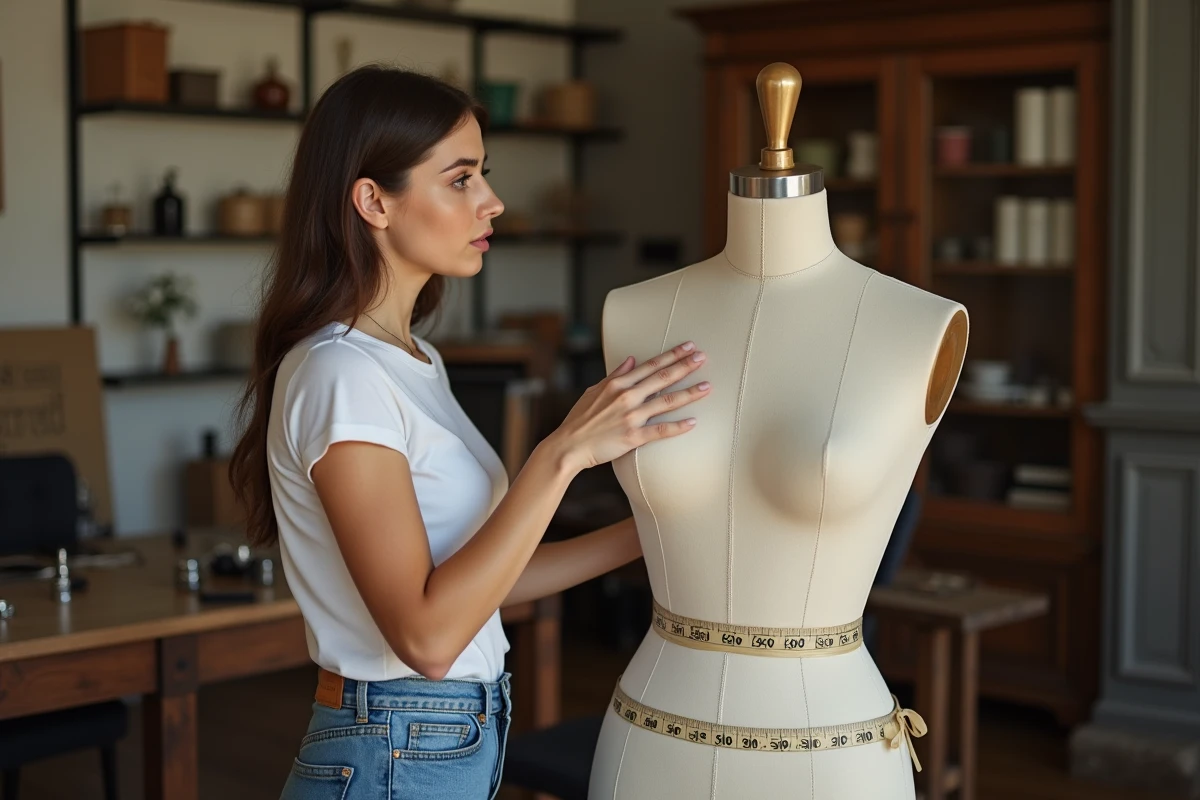
This sequence of numbers, 90-60-90, has crossed decades without ever disappearing from conversations about the ideal appearance. Its persistence is surprising, given that body diversity occupies a more visible place in public debates today.
In some circles, this combination retains its status as an untouchable reference; elsewhere, it resembles a relic of another time. Yet, this triptych has never constituted a universal rule, far from it: even the icons who have marked the runways and magazines have not always adhered to these proportions.
90-60-90: where does this standard come from and what do these numbers really mean?
Behind the equation 90-60-90 lies one of the most enduring aesthetic benchmarks of the last century. These values, measured in centimeters, refer to the bust, waist, and hip measurements. They embody a vision of the female body elevated to a model by an entire industry since the 1950s. Marilyn Monroe, Jayne Mansfield, Sophia Loren: these names resonate as emblems of an era when curves were meant to be perfect and calibrated. However, this format is not based on any scientific foundation; it results from a collective construction, shaped by the imperatives of ready-to-wear, the rise of pattern-making, and advertising logic.
Examining the origin and significance of these measurements requires looking into the very creation of aesthetic standards. The fashion industry sought to impose a norm, a kind of template, intended to simplify the design of clothing and standardize their presentation. This logic gradually took hold, imposing this necessary passage for models, and then becoming a point of comparison for the general public. However, studies conducted notably by the University of Cambridge and the University of Texas prove that these numbers are merely a construction, far from an ideal shared by all. Attractiveness cannot be reduced to a series of numerical data.
The history of the 90-60-90 myth is marked by breaks. Twiggy, a key figure of the 1960s, shattered the archetype of voluptuous curves. Barbie, analyzed by Nickolay Lamm, illustrates the drift towards impossible proportions. To understand everything about the 90-60-90 measurements, one must put these numbers in parallel with the culture, industry, and artistic creation of the 20th century. Advertising sometimes attributes to them a universal significance that reflects only a partial and outdated vision of beauty.
Why have these measurements marked fashion and society?
It is not by chance that 90-60-90 has imposed itself in the fashion landscape. Behind this formula lies the demand for efficiency in ready-to-wear and haute couture. Workshops and production lines needed stable templates that could be reproduced identically on hangers and runways. This standardization gradually eclipsed the plurality of bodies, sidelining the richness of all morphologies.
Throughout the 1980s and 1990s, the wave of supermodels—Claudia Schiffer, Naomi Campbell, Cindy Crawford, Elle Macpherson—gave flesh to this standard, imposing the 90-60-90 silhouette as the pinnacle of desirability. The collective imagination appropriated this reference, relegating real physiological diversity to the background. The consequences were not long in coming: the obsession with the ideal, fueled by advertising campaigns and fashion shows, weighed heavily on the shoulders of entire generations.
This unique model has not been without effects. Among the observed repercussions are:
- An increase in eating disorders among teenage girls and young women.
- A massive recourse to cosmetic surgery in an attempt to approximate these proportions.
- A feeling of dissatisfaction or even self-rejection, sometimes rooted from childhood.
In light of the seriousness of the situation, countries like France and Italy have decided to regulate the use of excessively thin models. This turning point, although late, marks a collective awareness of the psychological and social impact of these imposed codes.
Lines are shifting today: fashion is beginning to value body diversity. Calls to represent all morphologies are multiplying, challenging the idea of a single valid model. Nevertheless, the myth of 90-60-90 remains firmly entrenched, even as it wavers under the pressure of new social expectations.

Between myth and reality: what place for 90-60-90 today?
This triptych of numbers, long held up as the supreme reference, is faltering in the face of the emergence of body diversity. On the runways, in advertising campaigns, we now see a variety of silhouettes—broad, slender, older, disabled. The body positive movement is establishing itself, claiming visibility for all shapes, all stories, far from the diktat of a single silhouette.
Social media plays a catalytic role in this transformation. Instagram, for example, offers influencers the opportunity to showcase unretouched bodies, to embrace scars or curves, to denounce the pressure of standards. This dynamic, balancing the normalization of a plurality of bodies and criticism of norms, significantly weakens the power of 90-60-90. Ashley Graham, Winnie Harlow, as well as senior or atypical models, embody this renewal in fashion and advertising.
Technology accelerates the mutation: with 3D measurement and on-demand production, clothing now adapts to every morphology. This concrete evolution makes the dictatorship of standards less pressing, opening the way to a personalization that breaks away from the one-size-fits-all mold.
The market is following the movement, driven by a growing demand for inclusivity. Diversity of shapes, origins, genders, ages: fashion is reinventing itself and beginning to write new criteria. The 90-60-90 remains a relic of the past, shaken by the power of contemporary realities. It remains to be seen whether these numbers will eventually fade completely from our imaginations or if they will forever remain the ghost of a bygone ideal.